We had half a dozen books on board Callipygia listing assorted ideas to solve common boat problems. We went to these when we had an issue to resolve and we needed some fresh ideas. Here are some of the ones we tried and used, either from our own or other cruisers' ingenuity, or from these books.
Keeping a boat clean and looking good requires much work. We did better with this at some times than at others. It was always easier if we kept on top of it, rather than letting it go until it was a big job. Callipygia had a lot of deck teak and metalwork above, and lots of lovely woodwork below (see the Photo Album). Here are some handy shortcuts we used to try to minimize the amount of effort this took.
- After each passage, wash down the deck metal and blocks using a sponge and a bucket of fresh water, a little vinegar, and some Joy (dishwashing liquid). Wipe off rust spots using a green 3-M scuff pad.
- Keep bronze/brass fittings polished using a green 3-M scuff pad and vinegar, wiping them down with oil (we use baby oil) afterwards.
While Callipygia had a great deal of room for stowage, we finally ran out of space. Here's some of the ways we used to create quite a bit of additional and convenient space.
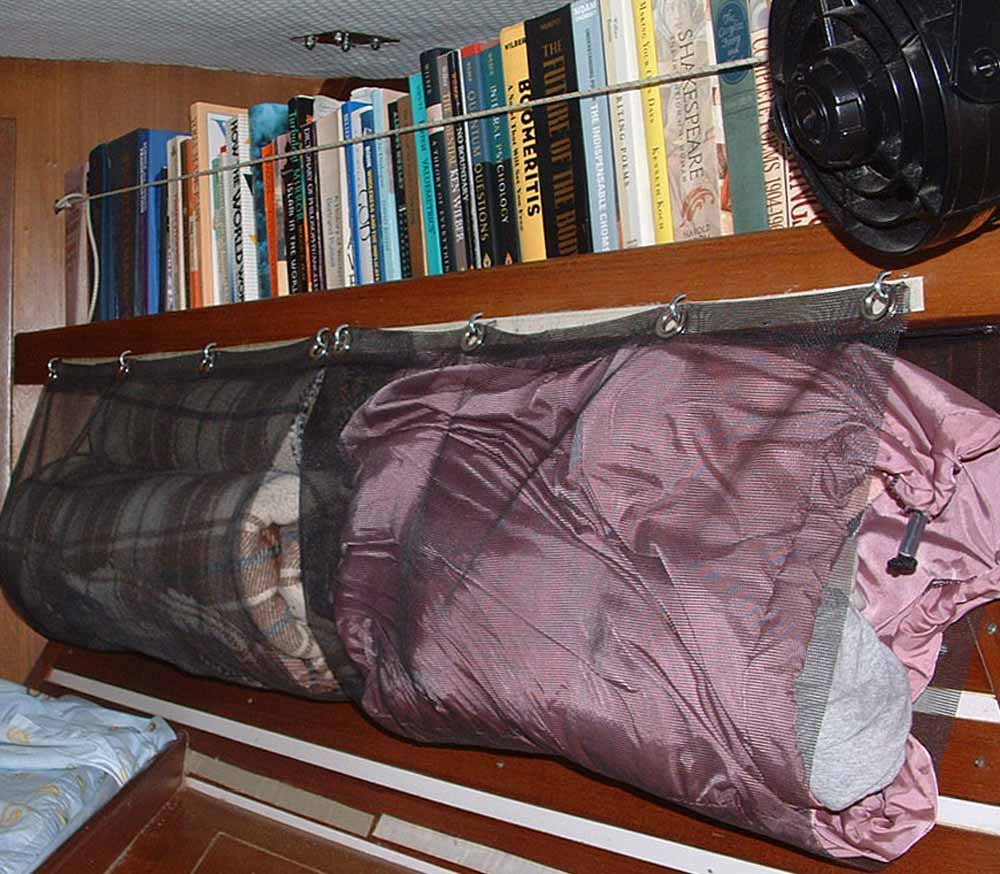
- Netting Lockers: We had shelves running the full length of the sides of the V-berth and on one side of the quarter berth. In the V-berth, the shelves were full of books. There was empty space under these shelves where the sides of the boat sloped in towards the beds. So we made "netting lockers" to hold light-weight items like blankets, linens, dirty laundry, etc.. To make the "lockers", we bought heavy-duty, fine-meshed, black nylon netting (screen quality). We cut it into pieces 18" wide by 36" long. We used 4 pieces on one side of the V-berth, 2 on the other side, and 2 on the quarter-berth (that's how long the shelves are). On one (narrow) end of each netting piece, we made a 1+ inch hem and put in 3 grommets. The other end we made a triple hem, 1/3" wide. The triple-hem end we attached to the bottom of the bookshelves next to the hull with a row of screws with washers. On the bottom of the open edge of the bookshelves, we screwed hooks to hang the grommets on. Worked great. [We tried it first using velcro and glue, but after a while it all turned into a sticky mess and we started over.]
- Wall Pockets: We went to an office supply store, and bought several acrylic (lexan-type) wall pockets. We had several of these screwed up on the bulkheads -- one above each pillow in the V-berth, one above the nav station, one in the galley and 3 in the main cabin. It provide places to put books, magazines, music, reference material (often kept in a clear plastic sleeve), cookbooks, catalogs, whatever. We clipped our Boat Cards to the outside of the one above the nav station, and our shopping list on the outside of the one in the galley.
- Hammocks: We bought some "gear hammocks" and had three of them strung up in the main cabin. Fortunately our cabin ceiling was high, and they were over seating areas so they weren't in the way. One was filled with plastic containers of all sizes--we were always needing one or another for something. A second hammock carried spare paper towels and toilet paper, and ziplock bags with snack food, and the third hammock had all our games and fun stuff (frisbee, cards, cribbage board, juggle balls, Mastermind, Hoyle, yoyo, etc). We also kept tourist maps we collected in this one, and other tourist information we were currently using.
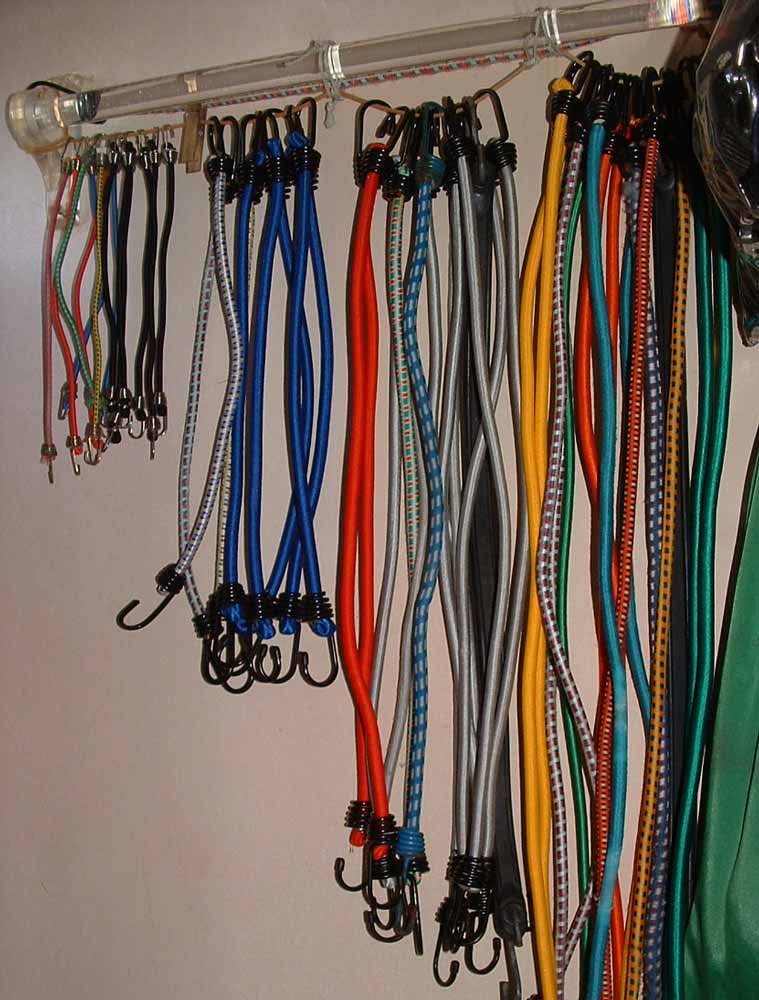
- Bungies. We used a lot of bungies and rubber bands. We struggled with ways to store the bungies so that we could easily get one of the size we wanted, but no matter what we did, it seemed that the hooks consistently got tangled round each other. Then we finally came up with a solution that worked. We put a bungie behind a towel bar in the shower, and tied a piece of line along it. Then fastened the line and bungie to the bar at increments along its length. Then we hung the bungies, sorted by size, along the line. Worked great! We put a line (or bungie) in front of them to stop them falling away from the shower wall when we were on an offshore passage.
When we first moved aboard and left our home port, we provisioned as if we were never going to find another grocery store or place to eat for months. Big mistake. After two years we still had cans left, and we'd thrown out a bunch of the dry stuff because, after a year, we got a weevil infestation. So we learned the hard way. We found that in the tropics, we often ate lunch out--especially in places where it was cheap. We found it was too hot to do a lot of cooking. We found we liked buying what the locals were eating. We missed a few things (maple syrup) that we couldn't get, but other than that we found we could get what we needed by going to the local grocery every 3-4 days, finding where/when the local market was, and taking a periodic bus trip to the nearest supermarket. Since we weren't doing passages of more than a few days, and were spending much of our time at anchor near a town or village, we therefore changed our approach. We no longer kept a lifetime supply of cans and dry goods on the boat. We always had enough so we could get by for a couple of weeks, but that's all.
When we began planning our ocean crossing, however, we had to go back to the drawing board. We made a list of broad food groups, figured out how many servings of each of those one person would eat each day (or each week). Then we figured out how much a serving was. We multiplied the number of servings of each group by the number of crew we'd have, to get an amount we'd need for each week. We multiplied that by 6, to get us to the Azores comfortably. Then we looked at the list and thought about where on earth would be we put/keep all this stuff. We made a storage plan. We' planned to restock for fresh items in Bermuda. Based on what we learned about our eating patterns on that first leg, we would then do a little restocking.
We expected that food would be a big deal during the Atlantic crossing--although we figured we wouldn't eat that much for the first couple of days (proved to be true). We found that on night watches everyone would hunt up a snack. Also, that in the late afternoon (weather permitting) a light social time with a small glass of wine or beer and a munchy was a very welcome addition to the daily routine.
Here's the list of food groups, with the number of servings we estimated for one person for a day or week:
- bread, tortillas, scones, muffins, pancakes (2/day)
- butter, mayonaise (2/day)
- potatoes, rice, pasta, couscous, noodles, dumplings (1/day)
- cheese, peanut butter (5/week)
- mustard, pickles, salsa, hummus (2/day)
- eggs (4/week)
- fruit: fresh, canned, dry (2/day)
- fruit juice (1/day)
- tea, hot chocoloate, hot cider (2/day)
- coffee (2/day)
- meat: beef, chicken, turkey, ham, sardines, tuna, salmon (1/day)
- milk for coffee, cereal, cooking (2/day)
- oil, salad dressing (2/day)
- pudding, yoghurt, cookie, cake (1/ day)
- snackies: bars, chips, crackers, candy, goo, ramen noodles, nuts, (2/day)
- soda, iced tea (1/day)
- veggies: fresh or canned (4/day)
- beans: black, red, white, refried (3/week)
- wine, beer (1/day)
- sauce fixings: gravy, pesto, bolognaise, curry, chinese, tomato paste, soy sauce, etc. (1/day)
- miscellaneous items: spices, raising agents, vinegar, etc.
- paper goods: paper towels, toilet paper, ziplock bags, foil, Joy.
Next we inventoried what we already have on board, and tossed items that were a year or more older. We cleaned out each area (including the refrigerator) with vinegar and water solution, then a mild clorox wash before we started provisioning, which we did in several trips. Cans first, then drinks, then dry goods, and fresh items the day before we leave. We discarded as much packing as we could, and pack dry items in (double) ziplock bags. We made an inventory of where everything was, with backup supplies in harder-to-reach places.
Here's a few ideas to save on cooking fuel:
- To cook rice, bring rice and water to a boil, cover and turn off heat. Let sit at least an hour. If necessary to reheat, or finish cooking, bring back to the boil, cover and reduce heat to cook a few more minutes.
- Make a solar cooker. We experimented with trying to make one that would hang on the lifelines on the sunny side of the boat. We never did get a design that worked, although we had friends who did.
Somehow the stopper knot at the mast end of one of our jiffy reefing lines came undone-and the line disappeared into the boom one day as we hoisted the sail. With the help of Steve of FKG Rigging in Sint Maarten, we got it back. Here's how.
- One person (A) stands at the stern end of the boom and another (B) stands at the mast, both looking at each other through the boom.
- A feeds a piece of lifeline (rigging wire) carefully into the boom towards B.
- When B gets the the end of the piece of lifeline, he attaches a messenger (thin line/string) to it with a rolling hitch a foot from the end, then 3-4 loose half hitches going back towards the end. Then put electrical tape round everything so nothing will catch as it's drawn back through the boom.
- B ties off his end of the messenger at the mast, and A pulls the rigging line back to bring the messenger with it through the boom. When s/he gets the messenger, s/he ties it off on something.
- B attaches the messenger to the reef line the same way it had been attached to the rigging wire. Then A carefully and gently draws the messenger through, drawing the reef line with it.
Bill Dillon (KG4QFM)
and
Pat Watt (KG4QFQ)
This page was last modified on
August 9, 2009
Copyright 2005 The Trouser Rollers. All Rights Reserved.
www.callipygia600.com